
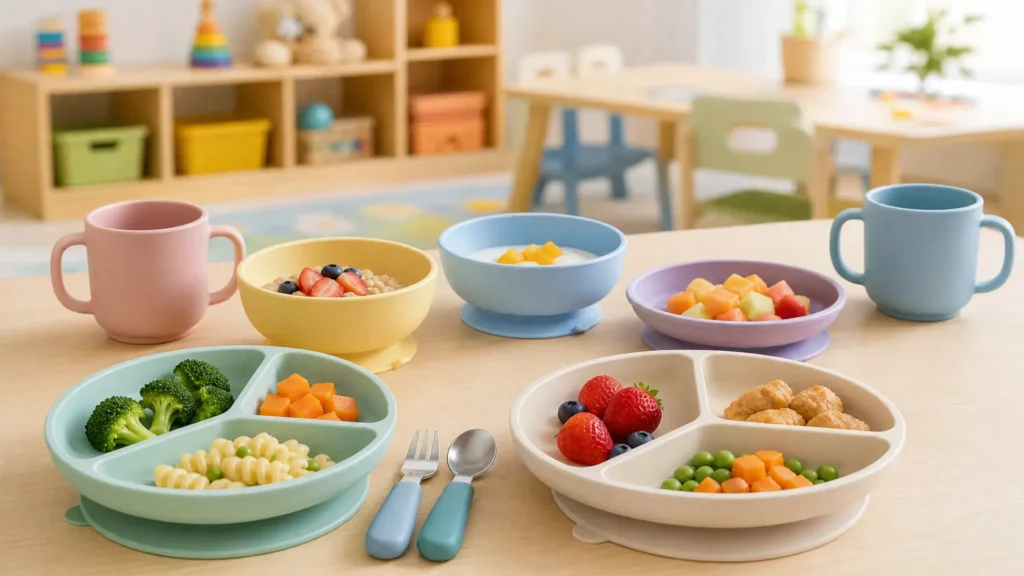
Buying toddler divided melamine plates for a 100-child facility works nothing like buying a set for a home kitchen. This guide covers what separates institutional-grade divided plates from retail-shelf versions, and how to write a spec that makes your next bulk order pay for itself.
Why Flat Plates Cost You Staff Time
Most centers start with flat plates because they are cheap and familiar. Few stay with them. The gap shows up in your daily service routine rather than on a spec sheet.
| Meal-service factor | Standard flat plate | Divided plate with suction base |
|---|---|---|
| Food mixing | Foods run together and children reject the plate | Sections hold protein, vegetable and starch apart |
| Spills and drops | Frequent, and each one pulls a caregiver away | Much lower once the base is seated |
| Portioning | Staff eyeball it or reach for extra bowls | The compartment acts as the measure |
| Cleanup per meal | Floor, table, chair and child | Wipe the plate |
This table reflects meal-service routines described by daycare buyers, not laboratory measurement. Your own figures will shift with staff ratio, table surface and menu.
Every spill pulls a staff member out of the room to retrieve the plate, wipe the surface, sanitize if the mess reached a shared table, then re-serve. Across a room of toddlers those interruptions add up to labor minutes nobody budgets for in September.
Portion Control at the Serving Line
Flat plates push the portioning problem onto your staff. A meal that needs a protein, a vegetable and a starch in set amounts forces a caregiver to judge ratios by eye or pull out three bowls, and that slows the line during the busiest ten minutes of the day.
With a divided plate you set the portion once, when you approve the mold. After that, a new hire fills each section to its natural line and serves a compliant meal without memorizing gram weights. Centers that follow state nutrition guidelines or sponsor a federal meal program get a second benefit: auditors and parents both read a tidy, balanced plate as evidence of care.
Home Use and Institutional Use Are Different Jobs
Basic kids melamine plates work well at home. Institutional service asks more of the product, which is why suction bases and heavier wall sections belong on the spec.
A home plate serves one child three times a day. A daycare plate rotates across dozens of children, runs through an industrial dishwasher, and meets chemical sanitizer on the table hundreds of times a month.
Food waste is the second cost most buyers miss. A child in the middle of a picky phase who sees textures touching will often reject the whole plate rather than pick through it. That rejection turns into wasted food, a second serving attempt, and more staff time. Compartments remove the trigger without asking your team to change a single routine.
Compartment and Suction Base Design
Two engineering decisions carry most of the performance in toddler divided melamine plates: how the sections are shaped, and how the base stays put.
Compartments That Suit Picky Eaters
Young children pass through a normal developmental stage called food neophobia, a wariness toward new or mixed foods. Published research puts the peak between roughly ages two and six, which covers most of the room at lunch. Treat it as a protective instinct rather than defiance, and design around it.
Three separated compartments let a child eat the one food they accept without worrying that the other two will reach it. Check these points before you approve a sample:
- Wall height against your wettest dish. Shallow ridges let thin sauces bridge between sections. Ask for the cross-section drawing, then run a real sample with your runniest menu item instead of trusting a product photo.
- Section volume against your menu. Cereal, yogurt and fruit need different geometry from dry solids. A plate that photographs well can flood with one spoon of oatmeal.
- Rim and grip. A slight lip helps a toddler push food onto a spoon rather than off the edge.
The operational payoff is lower food waste and fewer power struggles at the table. Staff spend less energy coaxing bites and more energy watching the room. Tables also clear faster, trays reach the wash window on schedule, and the next activity starts on time.
What the Suction Base Buys You
A food-grade silicone suction ring forms a vacuum seal against smooth surfaces, which covers the laminate and molded-plastic tables common in daycare rooms. Once seated, most toddlers cannot lift, flip or throw the plate.
That matters in two places on your budget:
- Cleaning labor and slip risk. Fewer plates reach the floor, so staff wipe less and the room stays safer underfoot.
- Serving capacity. One caregiver covers more children per round without stopping to reset dropped plates.
Seal quality depends on two things buyers rarely check:
- Silicone durometer. Too hard and the ring will not conform to the table. Too soft and it deforms in the dishwasher.
- Flatness of the plate underside. A warped base will never hold, however good the ring. This is why you sample a real production unit rather than a showroom prototype before committing to a bulk order.
One manufacturing detail decides whether the base survives a year of service. The factory must mold the suction base as part of the same shot rather than glue it on afterward. A glued base leaves a seam where moisture and food collect, and that seam is where the failure starts. Suppliers using compression molding for melamine tableware can produce a single-body plate with no joint to trap bacteria.
Material Safety for Institutional Buyers
Toddler divided melamine plates end up in the hands of children under five, which puts material safety outside the price negotiation. A plate that fails a migration test has no unit price worth quoting.
A5 Melamine and Lower Grades
| Grade | Composition | Suitable for children’s tableware |
|---|---|---|
| A5 | 100% melamine-formaldehyde molding compound | Yes. This is the grade to write into your spec. |
| A3 / A1 | Melamine resin blended with urea-formaldehyde filler | No. Cheaper to mold, higher formaldehyde release in service. |
A5, A3 and A1 are trade designations used across the melamine tableware industry rather than an official international standard, so the label alone proves nothing. Ask for the material declaration and the migration report together.
Pure A5 contains no BPA, resists staining and odor absorption better than cheap polypropylene, and stays dimensionally stable at normal serving temperatures. Under correct use, formaldehyde and melamine migration stay well inside regulatory limits.
The Heat Rule Worth Posting in Your Kitchen
Melamine resin is a thermoset, so a commercial dishwasher will not melt or soften it. A microwave behaves differently. Microwave heating drives the surface temperature up quickly and pushes migration up with it, which is why FDA guidance tells users to keep melamine out of the microwave altogether.
Three practical rules for a daycare kitchen:
- Reheat in the kitchen, plate at the window. Use ceramic or a microwave-rated container for reheating, then transfer to the melamine plate.
- Serve warm, not scalding. Melamine suits normal served-meal temperatures rather than food coming straight off a steam table or stove.
- Watch acidic dishes held hot. Tomato and citrus preparations held at temperature on the plate raise migration more than neutral foods do.
FDA, LFGB and the EU Import Paperwork
| Standard | Market | What it covers |
|---|---|---|
| FDA 21 CFR | United States | Baseline food-contact compliance for melamine ware |
| LFGB | Germany, widely demanded across the EU | Stricter sensory and migration testing than the US baseline |
| Regulation (EU) No 10/2011 | European Union | Melamine migration limit 2.5 mg/kg, formaldehyde limit 15 mg/kg |
| Regulation (EU) No 284/2011 | EU imports from China and Hong Kong, China | Declaration of compliance plus a laboratory report for every consignment, with border checks on a share of shipments |
That last row catches importers out. Melamine kitchenware shipped from China into the EU travels under a consignment-level declaration and lab report, so your supplier’s paperwork discipline becomes your customs clearance risk. Before you sign a purchase order, request third-party test reports confirming the goods meet the relevant food-safe melamine standards for your destination market.
If you sell into both the US and the EU, source to the stricter of the two and one specification covers both.
Reading a Test Report in Three Checks
You do not need a chemistry background to judge a report. Look for three things:
- A named laboratory and a named standard. “Food safe certified” is marketing copy. “SGS, EN 1186, Regulation (EU) No 10/2011” is a claim you can verify.
- Your SKU or mold number on the document. A report covering a cousin product tells you nothing about the plate in your carton.
- Measured migration values below the legal limit. Formaldehyde and melamine monomer are the two figures that matter, and the report should print the numbers rather than a pass stamp alone.
A serious supplier hands over a dated, batch-linked report without hesitation. A vendor who stalls or sends a generic company certificate has told you what you need to know about the price.
Bulk Order Checklist for Toddler Divided Melamine Plates
Use this list when you send out an RFQ. It filters out most unsuitable suppliers before the first sample lands on your desk.
- Removable, heat-rated suction base. Confirm the silicone survives commercial machines that finish with an 82°C (180°F) sanitizing rinse without warping or losing grip. A removable ring also lets staff deep-clean the underside, which sealed designs prevent.
- Compartment depth matched to your menu. Request a cross-section drawing and compare it against what you serve on a Wednesday, not against the catalog photo.
- Molded construction, never glued. A single-body plate has no seam to trap bacteria and no joint to fail under daily industrial washing.
- Customization that survives the dishwasher. Many centers print a logo or a child-friendly pattern into the base of each compartment, which helps trace strays back to your facility. Confirm the print method is food-contact safe and dishwasher stable.
- Batch-level documentation. Require reports for the exact SKU and production run you are buying. Tie a payment milestone to receiving and accepting that paperwork.
Lead Time and Tooling
Bulk volume opens negotiating room on schedule as well as price. Standard designs commonly quote around 20 to 30 days. New molds or Pantone matching for your branding add development and sampling time on top, and the exact window varies by factory, so confirm it in writing before you plan a rollout.
Ask for a production schedule with checkpoints rather than a single delivery date sitting three months out. Checkpoints give you somewhere to intervene if the sample comes back wrong.
Browse the children’s melamine dinnerware range to match a compartment layout to your actual menu. Getting that match right decides whether a plate lives in the wash rotation or in a storeroom.
What to Settle Before Your Next Order
Well-specified toddler divided melamine plates return their cost through three lines you already track: food waste, cleaning labor and parent satisfaction. Swap the plates and your staff spend those recovered minutes supervising instead of wiping.
Settle four points before you release the order. Confirm 100% A5 resin, a molded suction base, compartment geometry tested against your own menu, and batch-level FDA or LFGB reports naming your SKU. Every other variable is negotiable.
FAQs
Are divided melamine plates safe for toddlers?
Yes, when they are molded from 100% pure A5 melamine and backed by current migration testing. A5 melamine contains no BPA, and formaldehyde and melamine migration stay within FDA and EU limits at normal serving temperatures. Avoid unbranded plates sold without a material declaration.
Can you microwave melamine plates?
No. FDA guidance advises against microwaving melamine because rapid surface heating increases chemical migration. Reheat food in a microwave-rated container, then serve it on the melamine plate.
How much do suction bases help in a daycare?
A silicone ring seals against smooth cafeteria tables and stops most toddlers from tipping or launching their plate. Centers using them report less floor cleaning, fewer slip hazards and shorter turnaround between sittings.
Are these plates commercial dishwasher safe?
Yes. Toddler divided melamine plates molded from A5 resin with food-grade silicone bases handle commercial wash cycles and sanitizing rinse temperatures without warping or losing suction. Color and gloss will soften gradually over years of high-volume washing, which is normal wear rather than a defect.
What is the lead time for a custom bulk order?
Standard designs commonly ship in 20 to 30 days. Custom molds or specific Pantone color matching extend that while the factory develops tooling and runs samples. Ask for the sampling date and the production start date as separate milestones.
Short version: For group childcare, specify 100% A5 melamine, three compartments deep enough for your runniest menu item, and a food-grade silicone suction ring molded into the same body as the plate. Ask for batch-level FDA and LFGB migration reports tied to your exact SKU. These plates handle a commercial dishwasher. They never go in a microwave.
Cutting spills and food waste at your center starts with the right plate. Send us your menu, table surface, and we will spec a layout that fits your service. Request a sample kit and bulk quote.