Introduction
If you’ve ever watched a toddler eat, you know mealtime is chaos. A spoon becomes a drumstick. A cup becomes a projectile. And that ceramic plate you thought looked nice? It’s now in pieces on the floor. Every parent, daycare worker, or school cafeteria manager has been there. Glass and porcelain look great for adults who sit still. For kids who do not, they are a safety hazard.
That is why so many parents and institutions have switched to durable tableware. Kids melamine plates have become the everyday choice because they actually work. They survive drops, rough handling, and repeated washing. Good melamine plates for kids give you the toughness you need and the light weight kids can handle. The bright colors also help make meals more appealing for children.
What Makes Melamine Suitable for Children
Understanding Pure Melamine Resin
Melamine dinnerware starts with melamine resin mixed with organic cellulose. Manufacturers mold-cure the mixture under heat and pressure. When they use 100% pure food-grade melamine molding powder (A5 grade), the result is a hard, dense thermosetting polymer that keeps its shape.
Regular plastics like polypropylene or polyethylene bend under pressure and hold onto grease. A5 food-grade melamine does not. It also will not absorb odors. The surface is smooth and glossy, close to the look of porcelain, but much tougher when it hits the floor.
Safety Certifications and International Standards
Children’s dinnerware has to meet international food contact rules. Any tableware sold in major markets should pass these safety tests:
- FDA 21 CFR 177.1460 (United States Food and Drug Administration standards for melamine-formaldehyde resins).
- EU Commission Regulation No 10/2011 (European Union guidelines on plastic materials intended to come into contact with food).
- LFGB Section 30/31 (German Food, Commodities, and Feed Code, recognized for stringent chemical testing).
- GB 4806.7 (National Food Safety Standard for Food Contact Plastic Materials).
When melamine is fully cured under controlled manufacturing, it is non-toxic, BPA-free, phthalate-free, and free of heavy metals.
How Durable Tableware Simplifies Dining
The Toddler Self-Feeding Phase
Between 12 and 18 months, children start learning to feed themselves. This means sweeping arm movements, experimental throwing, and plates tipped onto the floor.
Kids melamine plates hold up to repeated drops from high-chair trays (about 80 to 100 cm) onto tile, concrete, or wood. They do not chip or shatter. Metal and ceramic dishes make loud, startling noises when they fall. Melamine lands with a dull thud. If you have a toddler who startles easily, or if you run a daycare and want to keep the noise level down, that quiet landing matters more than you might think.
Picky Eaters and Compartmentalized Meals
Many children simply refuse to eat when different foods touch or mix on the same surface. It is not always about taste. Sometimes it is about control, or texture, or just the way things look.
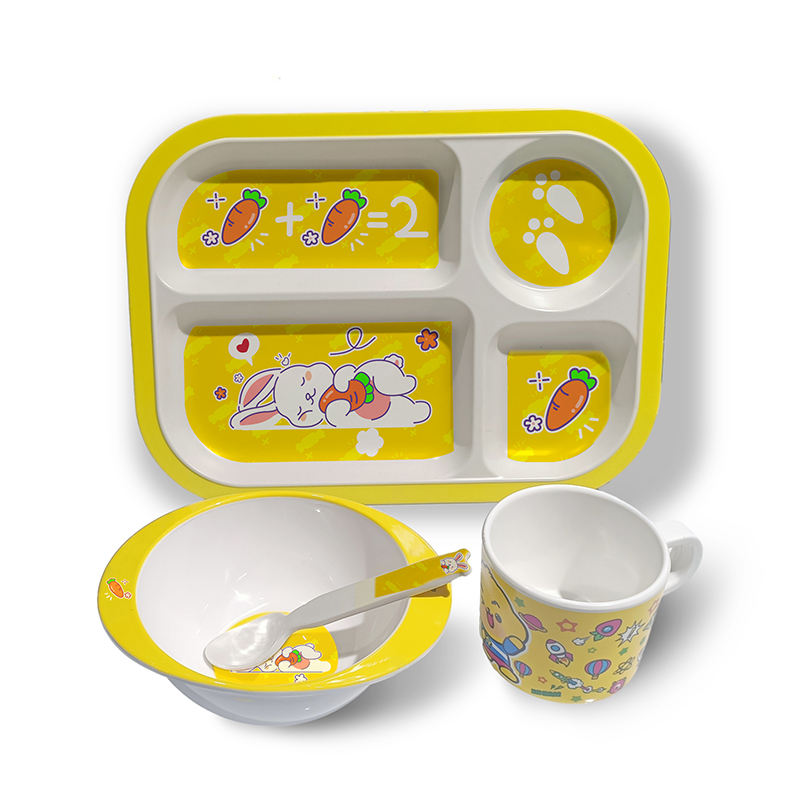
Divided melamine plates have raised inner walls that keep main dishes, vegetables, fruits, and sauces in their own zones. The vertical side walls also help toddlers who are learning to scoop rice, peas, or pasta with a spoon or fork. Food stays on the plate instead of sliding over the rim onto the table.
High-Traffic School Canteens, Daycares, and Outdoor Catering
Outside the home, places like daycares, kindergarten canteens, family-friendly cafeterias, and outdoor catering operations need tableware that can take a beating.
Melamine weighs less than half of what an equivalent ceramic dish weighs. Young children can carry their own trays without struggling. High-grade melamine also handles automated commercial dishwashers. It tolerates high water pressure and strong detergent cycles without clouding or losing its finish.
Comparing Tableware Materials for Children
So how does melamine actually compare to the alternatives? Here is a straightforward breakdown:
| Parameter | 100% A5 Melamine | Standard Ceramic | Stainless Steel | Soft Silicone |
|---|---|---|---|---|
| Shatter Resistance | High (Survives drops) | Very Low (Breaks into sharp shards) | High (Indestructible) | High (Flexible, unbreakable) |
| Weight | Lightweight | Heavy | Medium | Moderate |
| Surface Scratch Resistance | High (Hard polymer surface) | High (Glazed surface) | Moderate (Prone to scuffs) | Low (Prone to knife cuts) |
| Heat Insulation | Good (Low thermal conductivity) | Poor (Transfers heat quickly) | Poor (Heats up quickly) | Moderate |
| Dishwasher Safe | Yes (Top-rack recommended) | Yes | Yes | Yes |
| Microwave Safe | No | Yes | No | Yes |
| Porcelain-Like Appearance | Yes | Yes | No (Industrial look) | No (Matte rubbery feel) |
Key Manufacturing Considerations When Sourcing Kids Melamine Plates
If you are buying children’s tableware for retail, schools, or private-label distribution, quality depends on raw material purity and how the factory runs production. Look for certified manufacturers with strict quality control at every stage.
Material Verification: Pure A5 vs Modified Urea Blends
100% Pure A5 Resin meets global food contact safety standards. It has a non-porous surface. It resists odors and stays stable from -20°C to 120°C.
A1 and A3 blends contain urea-formaldehyde. They are cheaper, but they degrade under heat. They also release chemical residues and discolor. They are banned for direct food contact in North America and Europe. If you are a B2B buyer, always verify 100% A5 raw material test reports from SGS or TUV. Do not take the manufacturer’s word for it.
How Designs Stay on the Plates
Children’s plates often come with colorful animal prints, educational numbers, or custom brand artwork. Better manufacturing uses decal foil in-molding. Graphic patterns are applied during the secondary molding cycle. They are then sealed under a transparent, non-toxic protective melamine glaze layer.
Why does this matter? Because the food contact surface never touches raw printing inks. The designs do not peel or flake after hundreds of dishwasher cycles. They also will not fade. And the surface stays scratch-resistant against child-safe cutlery.
How to Care for Melamine Plates
Kids melamine plates are built for rough use, but basic care keeps them looking good for years.
Caring for Your Plates
Never microwave melamine or place it in conventional ovens. The resin absorbs microwave energy, which causes local overheating, micro-cracking, and structural breakdown of the polymer over time.
Do not put melamine tableware on direct flame, electric stovetops, or infrared heating lamps.
Melamine is dishwasher safe. At home, place dishes on the top rack. In commercial settings, use standard wash cycles with temperatures below 85°C.
Clean surfaces with soft sponges or microfiber cloths. Avoid abrasive pads, steel wool, or scouring powders that can scratch the protective glaze.
For stubborn food residues like tomato sauce or turmeric, pre-soak tableware in warm water with mild, neutral dish soap before washing. It saves time and elbow grease.
Conclusion
Parenting and running a food service both get easier when you pick practical gear that puts safety first. Kids melamine plates cut down on broken glass risks and make cleanup simpler. They also create a safer eating environment for children.
Global brands, schools, and hospitality suppliers looking for long-term manufacturing partners need verifiable raw material compliance. The right facilities provide the engineering and custom molding needed to deliver reliable tableware to families worldwide.
FAQs
Are kids melamine plates safe for daily use?
Yes. Kids melamine plates made from 100% pure food-grade A5 resin are non-toxic. They are also BPA-free, lead-free, and phthalate-free. They meet international safety standards set by the US FDA, European LFGB, and EU Commission Regulation No 10/2011.
How do divided kids melamine plates help picky eaters?
Divided plates have raised walls that keep different foods separated. This helps children who do not want their foods touching, and it makes scooping easier for toddlers still learning to use utensils.
Are melamine plates dishwasher safe?
Yes. High-quality kids melamine plates are completely dishwasher safe. At home, use the top rack. In commercial settings, they tolerate standard wash cycles up to 85°C.