
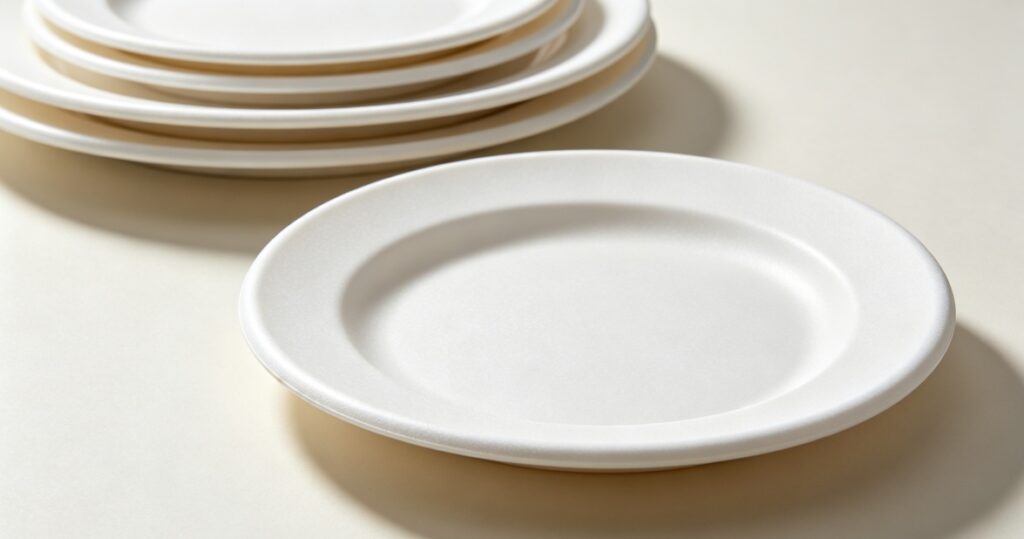
Most of the white melamine plates we ship end up in one of two places: a kitchen that has stopped replacing broken ceramic, or a studio that needs a surface the camera will not argue with. Two buyers with almost nothing in common, ordering the same product.
They converge on three things. A white that stays white. A finish that matches how the plate actually gets used. And a supplier who can repeat the color when you reorder eighteen months later. Shape, weight and rim profile are preferences after that.
This page works through those three in the order a buyer hits them: finish, whiteness, day-to-day care, then minimums and lead times.
Start With the Finish, Not the Shape
Finish is the decision buyers get wrong most often, because they choose it from a photograph. A gloss plate and a matte plate look like the same object on a screen and behave almost nothing alike on a table or in front of a lens. Settle the finish first and the shape question gets easy.
| If the plate spends most of its life… | Finish to sample first | What that buys you |
|---|---|---|
| In high-turnover service, buffets, poolside | Gloss white | Oil and sauce wipe off in one pass, and it handles constant washing |
| In front of a camera or in a display kitchen | Matte white | Scatters light, so highlights do not blow out |
| Outdoors, or in rustic and farmhouse service | Speckled white | The pattern hides scuffs between washes |
| Under warm lamps, at weddings and banquets | Bone white | Reads softer than a blue-white under tungsten light |
Sample two finishes and run both through a real service. That single carton settles arguments a spec sheet never will.
What White Does to the Food on It
Ask a chef why the base plate is white and the honest answer is about risk, not style. A white surface sends the true color of the food back at the diner. Beetroot reads as beetroot, saffron stays saffron, and a greyish sauce is a plating problem rather than a lighting problem. Put the same dish on slate or deep blue and the plate competes with the food, and the plate usually wins.
That is the whole argument for menu versatility. One white plate carries a spring tasting menu and a winter braise without anyone reprinting a brand guide. For a group with several properties it also solves a photography problem, since a dish shot in one location can be used for another without a reshoot.
Colored and patterned ranges sell well, and we sell plenty. They also date. A speckle that looked current in 2019 reads tired now, and a venue sitting on 400 of them either reorders a look it has gone off or replaces the lot.
White ages differently. It looks like it was always meant to be there. For a wider view of where white melamine fits in front-of-house service, note that the shift from back-of-house standby to front-of-house presentation happened over about a decade, and white led it.
Breakage, Weight and Replacement Costs
Buyers say durable and mean about five different things. Here is the version that shows up on an invoice.
Ceramic in a full service room breaks. Ask an operator how many plates they buy a year and the honest ones describe a quarterly reorder rather than a number, because very few kitchens track breakage precisely. White melamine plates move that line from a standing quarterly order to a top-up when the room expands.
Call them unbreakable and you are overselling: drop one off a loading dock onto concrete and it will crack. What they survive is the drop that happens five nights a week, onto tile, from waist height, in a room with a queue at the door. Staff notice this before management does, and they stop carrying stacks carefully, which speeds service up.
The chip is the cost nobody budgets for. A cracked rim goes back, the dish gets replated, and the ticket waits. Melamine does not chip the way glazed ceramic does in normal service, so that interruption mostly disappears. Ask a floor manager about the Friday night they ran out of clean plates and you will hear the real argument for switching.
| Facteur | White melamine | Céramique | Colored melamine |
|---|---|---|---|
| Annual replacement | Low single digits, commonly under 2% | Commonly 10% to 30%, varies by room | Low single digits |
| Weight, 27 cm plate | About 380 to 430 g | About 850 g | About 380 to 430 g |
| Batch color match | ΔE 1.0 or less under D65 | Glaze varies by firing | Dark shades drift more |
| Food color accuracy | Neutral and true | Neutral and true | Can cast onto food |
| Best fit | High turnover, outdoor, studio | Fine dining, formal service | Themed venues, brand colors |
Those are ranges from what we see across catering, hotel and restaurant clients, not lab results. A quiet tasting menu treats plates gently, a poolside buffet does not, and the gap between those two rooms is wider than any material spec suggests.
Batch Whiteness: the Number to Ask a Supplier For
White is the one color where a mismatch is visible. Put a new plate beside one from last year under a dining room light and a slightly different white reads as dirty rather than different.
We hold whiteness to a measured standard under a D65 light box and keep the color difference between production runs at ΔE 1.0 or less, which sits below what most people pick up side by side. Ask any supplier two questions before you commit:
- How do you measure batch color, and under which light source?
- Can you send samples from two different production runs, side by side?
A supplier with a process answers within a day and sends the samples without a fight. One without sends another photograph.
On Camera: Studio vs. Kitchen Needs
The studio argument is the part most buying pages skip. A stylist is not thinking about a two-year service life. They are thinking about what the sensor sees in the next thirty seconds.
White Balance and a Clean Reference
When the surface is white, the camera meters a clean reference and the food keeps its real color. A colored or patterned plate bounces its own hue back into the dish, and correcting that in post costs time on every single frame. Shoot days run tight, so a plate that removes a correction step is worth more than one that looks interesting on a shelf.
Highlights, and Why Gloss Is Hard to Shoot
A high shine surface throws a hard specular highlight straight into the lens, a bright blown-out patch that diffusion never fully removes. A matte or satin finish scatters that light instead. Photographers handle most of the rest with a polarizing filter and a scrim, but starting from a lower sheen removes half the fight. It is why studios keep a shelf of matte props that never go out on a table in service.
White plates for food styling also come down to geometry. A 27 cm plate under a 15 cm portion leaves a clean margin, and that empty ring is what makes a composed shot read as deliberate rather than crowded. Drop to 20 cm and the same portion fills the frame, which suits a tight crop or a menu shot where the food should look generous. Smaller 15 cm pieces handle starters and sweets.
Stains, Yellowing and Keeping White White
White melamine plates stain less than most buyers fear, and the honest answer still comes down to timing. Pure A5 melamine has a dense, non-porous surface, so most sauces wipe off if they are dealt with inside a couple of hours.
What Actually Stains, and How Long You Have
- Turmeric, curry, tomato reduction and strong coffee are the exceptions.
- Leave any of them overnight and they will tint the surface.
- That is a fact about pigments rather than a flaw in the material, and it is why we tell buyers to rinse rather than stack.
Getting a Mark Out
- A paste of baking soda and water left on the spot for about 20 minutes lifts most fresh stains.
- Stubborn marks respond to a short soak in diluted oxygen bleach. Think 15 to 30 minutes, not overnight.
- Skip steel wool and abrasive pads. Scratches are permanent, and they give the next stain something to grip.
Why Some Plates Yellow and Others Do Not
Yellowing usually traces back to the resin, not the cleaning. Cheap plates cut with filler or recycled scrap lack the cross-link density of pure A5, so they drift toward cream as they age, faster under heat, UV and chlorine. No cleaning routine rescues a bad resin, which makes it worth five minutes before you sign a volume order. Understanding how resin grade affects whiteness over time covers the dock tests that separate pure A5 from a urea blend.
Heat: Two Hard Limits
- Dishwashers are fine at the usual 70 to 80°C cycle. Do not hold melamine in the high heat dry zone for long stretches.
- Microwaves and conventional ovens are out. Melamine holds up to about 120°C in normal service, but a microwave heats it unevenly and can craze or crack the surface.
We say that second one to every buyer, including the ones who would rather not hear it, because a plate that fails in year one costs us more than a plate we never sold.
Four Checks before You Approve a Sample
Picking the best white melamine plates for an operation comes down to four things you can test without a lab. Run them against any commercial white plate, including a competitor’s, and the comparison is immediate.
- Poids tells you about resin content and wall thickness before you read a single line of the spec sheet.
- Run a finger around the rim. It should be smooth, with no flash, the thin ridge left where the two mould halves meet.
- Stack a dozen and look at the gaps. Even spacing means flat plates. Uneven spacing means warping, and warped plates do not sit safely on a bus cart.
- Hold one up to a light. A consistent translucent body with no cloudy patches points to a full cure.
White melamine plates that pass all four tend to last. Specified this way, white melamine dinnerware stays uniform for years rather than months.
MOQ, Lead Time and What Moves the Quote
White melamine plates wholesale orders usually start at 500 to 1,000 pieces per shape and color, with lead times of 15 to 30 days after sample approval. Whiteness consistency is the thing to specify up front, not after the container lands.
On white melamine plates bulk pricing, the number of shapes moves the quote more than the number of pieces, because every extra shape means another mould rather than a volume discount. Most of our restaurant clients settle on one or two shapes instead of a full range, which keeps reordering simple and the MOQ reachable.
Before you brief any factory, the custom plate specs restaurants should confirm first will save you a round of sampling. Order a kit with two finishes and one size up from what you think you need, then run it through a real service before deciding.
Questions Buyers Ask Before the First Order
1. Do White Melamine Plates Stain Easily?
Less than people expect, as long as the plate is rinsed within a couple of hours. Pure A5 melamine is dense and non-porous, so everyday sauces wipe away. Turmeric, curry, tomato reduction and coffee are the exceptions and will tint the surface if left overnight. A baking soda paste lifts most marks, and short oxygen bleach soaks handle the rest.
2. Are White Melamine Plates Good for Food Photos?
They are the default for a reason. A neutral surface gives the camera a clean white balance reference, so the food keeps its real color and needs less correction in post. Matte finishes work better than gloss because they avoid blown-out highlights. Leave negative space by choosing a plate roughly twice the width of the portion.
3. Which Finish Is Best for White Melamine Plates?
It depends on the job. Matte suits photography and display because it scatters light and flatters food. Gloss suits high-turnover service because oil and sauce wipe off cleanly. Speckled hides wear in rustic or outdoor settings, and bone white reads warm under tungsten lighting. Most venues sample two finishes of white melamine plates before committing to volume.
4. Do White Melamine Plates Turn Yellow Over Time?
Pure A5 resin holds its white for years under normal use. Yellowing comes from filler or recycled content in cheaper plates, and it accelerates with high heat, direct sunlight and long soaks in chlorine bleach. If a supplier cannot tell you what grade of resin they use, that silence is the most useful answer you will get.
5. White Melamine Plates in Dishwasher or Microwave
Dishwasher yes. White melamine plates run through the standard 70 to 80°C cycle without trouble, though long holds in the high heat dry zone shorten the surface life. Microwave no. Melamine holds up to about 120°C in service, but a microwave heats it unevenly and will craze or crack it, and conventional ovens are equally off limits. This is a material boundary rather than a defect, and honest suppliers state it up front.
6. What Is the Usual MOQ for a Custom White Plate?
Most OEM programs run 500 to 1,000 pieces per shape and color, with 15 to 30 days of lead time after sample approval. Consolidating shapes is the fastest way to hit a better price tier without overbuying a single size.
Where to Start
White is infrastructure, not a trend. Pick the finish that suits how you shoot or how you serve, insist on pure A5 resin so the color holds past year two, and standardize on a size range you can reorder for a decade. That is the whole strategy, and it is why plain white keeps showing up in studios and service kitchens long after the trend colors have gone.
Ready to spec your line? Browse our white melamine plate shapes and sizes and request a sample kit with two finishes plus wholesale pricing.
Inquiry for pricelist · sample kit with two finishes, plus wholesale pricing on your shapes.