
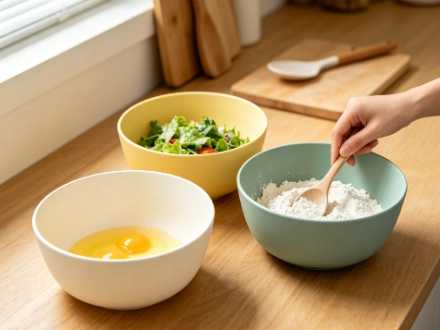
Walk into any busy kitchen and you’ll see three mixing bowls in the rotation: glass, stainless steel, and melamine. The question isn’t which one looks best in a catalog photo, but which one survives the drops, the heat, and the daily abuse of a real kitchen. Cooks argue about this constantly, and most of the arguments rely on assumptions rather than what actually happens when a bowl hits a tile floor at 7 a.m.
This comparison tests melamine mixing bowls against glass and stainless in the conditions that actually break bowls, not a spec sheet. We look at weight on a tired arm, what happens near boiling water, how each material behaves after a year of dishwasher cycles, and what the whole thing costs when you stop pretending nothing ever breaks. By the end you’ll know which material fits the way you actually cook, and which one is quietly costing you replacements.
The Three Contenders in a Real Kitchen
What Each Material Actually Is
Glass (Tempered)
A non-porous, see-through bowl that goes from counter to microwave to oven. It shows you exactly what’s inside, which matters when you’re folding batter or checking a dough.
Stainless Steel (304 Grade)
A metal bowl that won’t crack, won’t stain, and stays cool to the touch. Cold-sensitive tasks like whipping egg whites love it, and a stainless bowl shrugs off everything a microwave would do to plastic.
Melamine (Food-Grade A5)
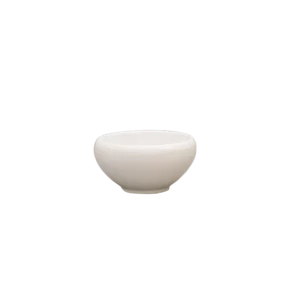
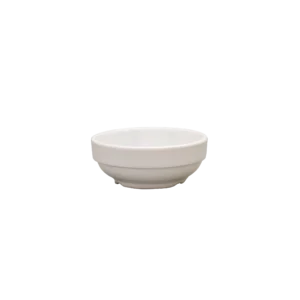
A food-grade A5 thermoset resin, not a soft plastic. Once cured it’s hard, light, and shatter-resistant. It’s the material behind most unbreakable cafeteria and restaurant bowls you’ve eaten from without realizing it.
Weight and Handling: Who Wins at the Counter
Weight sounds trivial until you’ve mixed ten batches of cookie dough in a shift. A heavy bowl fights you on every lift, tilt, and scrape. This is where material order matters more than any marketing claim, and where melamine mixing bowls pull ahead by a wide margin.
A 5-quart melamine mixing bowl weighs roughly a third of the same size in glass, and noticeably less than stainless. For anyone doing high-frequency prep, a home baker, a daycare cook, or a caterer setting up forty salads, that weight gap is the difference between finishing relaxed and finishing with a sore wrist.
The appeal is exactly why home cooks switched to melamine mixing bowls for everyday prep once they felt the difference at the counter.

Why Lightweight Bowls Reduce Fatigue
- Lighter bowls are easier to tilt when you pour batter into a pan without a second hand steadying the rim.
- Lightweight mixing bowls are safer on wet counters because they carry less momentum if they slip.
- Kids and older cooks handle them without strain, which is why schools and care homes spec them as their default prep bowls.
Glass sits in the middle and stainless is the heaviest. Steel’s weight actually helps when you’re vigorously whisking because it won’t slide, but it’s the first thing people complain about after a long prep session. If your cooking is occasional, weight barely registers. If it’s daily, it decides everything, and the best mixing bowls for meal prep are the ones light enough to reach for without thinking.
Heat and Hot Food: The Test That Matters
Here is the honest part most product pages skip. Heat is where melamine has a real limit, and pretending otherwise would waste your trust. Knowing the limit is what lets you use melamine safely for years, which is also why a melamine mixing bowl earns its place through everything except the microwave.
Can You Use Melamine Bowls for Hot Food?
Yes, with a clear boundary. Food-grade A5 melamine is safe for warm and room-temperature foods and holds up well with hot dishes straight from a pan up to about 70°C (158°F). Above that, the resin begins to soften and the risk of material migration rises, so you should not use melamine bowls for prolonged contact with boiling or near-boiling contents. This is also why the answer to “can you use melamine bowls for hot food” is always the same from us: fine for warm, not for scalding, never in the microwave.
Safe: tossing warm pasta, holding a batch of just-cooked vegetables, serving soup that’s cooled a few minutes. Avoid: microwaving, holding rolling-boil sauces for 20 minutes, baking.
For heating, move the food to glass or ceramic first, then transfer to melamine for serving or stretching. That single habit keeps a melamine mixing bowl looking new for years, and it’s the same discipline pros use in every high-volume line.
How Glass and Stainless Handle Heat
Glass takes microwave and oven heat without complaint. It is the only one of the three that does both.
Stainless handles hot contents and stovetop-adjacent work, though it’s rarely used inside an oven as a mixing vessel.
On the heat axis, melamine vs stainless steel mixing bowls isn’t close. Steel wins, but that gap only matters for the small share of prep that involves live heat.

Durability: Drops, Dings, and Dishwashers
Durability is where the conversation flips. The material that loses on heat often wins on survival, and survival is what you care about when a bowl slips. If you’ve ever asked whether melamine mixing bowls are safe for the long haul, the answer rests on what the material is made of and how it’s certified.
The Shatter Question: Glass vs Melamine
Glass shatters. Drop a tempered glass bowl on a tile floor and you’re sweeping up shards and tossing the food. A melamine mixing bowl, by contrast, is built to take the hit. It may chip at the rim but it doesn’t explode into pieces, which is why it dominates marine, cruise, and outdoor service where breakage isn’t an option. Stainless lands between them: it won’t shatter, but a hard drop dents it permanently and a dented bowl wobbles on the scale.
- Glass: highest shatter risk, highest injury cleanup.
- Melamine: shatter-resistant, occasional rim chip, still usable.
- Stainless: won’t shatter, but dents and holds the dent.
Stain and Scratch Resistance
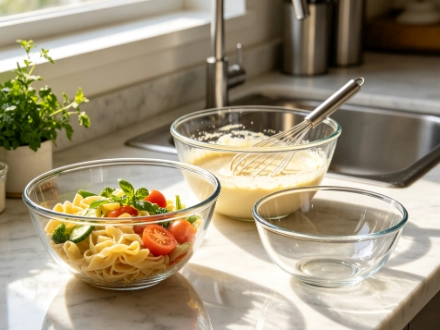
All three beat soft plastic on stains. A melamine mixing bowl’s non-porous surface doesn’t absorb odors or tomato color the way polypropylene does, though it’s not magically stain-proof (more on that below). Stainless shrugs off both stain and scratch. Glass resists both but shows every scratch as a cloudy streak. For everyday confidence, insist on certified A5 food grade (FDA 21 CFR 177.1460 / EU 10/2011 / German LFGB) so you know the bowl is safe for food contact.
The table below sums up where each material wins and where it gives ground.
| Dimension | Glass | Stainless | Melamina |
|---|---|---|---|
| Peso | Medio | Heaviest | Lightest |
| Microwave | Yes | No | No |
| Oven | Yes | No | No |
| Lavavajillas | Yes (top rack) | Yes | Yes (top rack) |
| Shatter risk | Alto | None (dents) | Low (chips) |
| Stain / scratch | Scratches cloud | Resists both | Resists stain; surface scratchable |
| Price | Mid, replace often | High upfront | Low, rarely replaced |
Mixing, Whisking, and Baking Performance
A bowl’s job is to help you combine food without fighting you. Each material brings a different feel to the work, and the right one depends on the step you’re in.
Do Melamine Bowls Stain or Scratch
A melamine mixing bowl can pick up color from strongly pigmented foods like turmeric, beet, or a long sit in tomato sauce, but because the surface is non-porous, a soak with baking soda lifts most marks without scratching the bowl. Use a soft sponge, not steel wool, and the bowl stays presentable for years. The non-porous surface is also why it doesn’t carry last night’s garlic into this morning’s custard, and why “do melamine bowls stain” is a fair question with a reassuring answer: only if you leave them dirty.
Are Melamine Bowls Good for Baking
For the prep side of baking, absolutely. Melamine mixing bowls are excellent for measuring, combining dry ingredients, kneading softer doughs, and letting yeast dough rise. They’re light, stable, and easy to scrape clean. What they don’t do is go in the oven, so once your dough is shaped, move it to a baking pan or stone. If your question is whether melamine bowls are good for baking, the fair answer is: perfect for everything before the oven, not a substitute for the oven itself. As baking bowls go, melamine covers the entire prep stage, while stainless stays coldest for whipping and glass lets you watch an emulsion form.
- Use melamine for: cookie dough, pancake batter, bread knead-and-rise, salad dressing, marinades.
- Use stainless for: egg whites, cream, anything you want cold.
- Use glass for: microwave-melted butter, watching a sauce thicken.
Cost Over a Year of Real Use
Specs don’t break; bowls do. The real cost is replacement, not sticker price. Run the numbers for a year of actual use and the ranking shifts in favor of the material that almost never shatters.
- Melamine: lowest total cost. Cheap to buy, almost never replaced because it doesn’t shatter. A set of durable melamine mixing bowls pays for itself the first time a glass set would have meant a trip to the store.
- Stainless: high upfront, near-zero replacement. You buy once and inherit it to the next apartment. Best long-term value if the weight doesn’t bother you.
- Glass: mid price, but the replacement tax is real. Every dropped bowl is a new purchase and a cleanup bill.
For a home cook, the gap is a few dozen dollars. For a commercial kitchen running dozens of bowls a day, the difference is thousands, which is why food service buys melamine by the case and treats glass as a specialty item.
How to Choose the Right Mixing Bowl
No material is “best.” The right one follows your routine. Start with size, then match material to the jobs you actually do most, using the comparison above as your shortcut.
Size, Nesting, and Storage
Most kitchens want three sizes, not one heroic bowl. Nested melamine mixing bowls save the cabinet space a single oversized bowl would waste, and melamine nests tightly because the walls are thin and uniform.
- 1–2 qt (1–2 L): single servings, vinaigrettes, a packet of muffin batter.
- 3–4 qt (3–4 L): the daily workhorse for cookie dough, salad for four, and weekend pancakes.
- 5 qt and up (5 L+): large melamine mixing bowls for batch cooking, bread loaves, and tossing a big green salad.
If cabinet room is tight, large melamine bowls for tossing pasta nest inside smaller ones and free up the shelf that a glass set would eat. As salad mixing bowls, melamine’s light weight makes tossing effortless instead of a two-handed struggle.
| Capacity | Best for | Good for |
|---|---|---|
| 1–2 qt (1–2 L) | Single servings, dressings, small batches | Singles, quick prep |
| 3–4 qt (3–4 L) | Daily dough, salad for four, weekend pancakes | Most households |
| 5 qt+ (5 L+) | Batch cooking, bread, big salads | Families, meal prep, food service |
Material by Use Case
- Daily prep, kids, outdoor, high-volume service → melamine mixing bowls. Light, unbreakable, easy to wash.
- Whipping, cold prep, “buy it once” → stainless. Heavy but immortal.
- Microwave melting, oven-adjacent, visual monitoring → glass. Fragile but transparent and heat-safe.
Beyond the bowl itself, mixing bowls with lids turn prep into storage and keep a batch fresh without a separate container. For most homes, the best mixing bowls for meal prep are the ones light enough to use daily yet sturdy enough to last.
Common Mistakes to Avoid
The errors we see most aren’t about brands. They’re about mismatched expectations. Skip these and any of the three materials will serve you well.
- Buying glass for a toddler or a campsite. It will break; that’s not a defect, it’s physics. Choose shatter-resistant melamine mixing bowls instead.
- Assuming melamine is microwave-safe. It isn’t. Heat the food in glass or ceramic, then move it to melamine.
- Picking stainless for a small kitchen because “it’s the toughest,” then hating the weight every single day. Tough isn’t the same as right.
- Shopping on price alone and landing recycled or non-food-grade melamine. Insist on certified A5 food grade so you know it’s safe for food contact.
Preguntas frecuentes
Can melamine mixing bowls go in the microwave?
No. Like other melamine tableware, standard A5 melamine should not go in the microwave. The energy softens the resin and speeds material migration. Heat food in glass or ceramic, then transfer to a melamine bowl for serving or mixing.
Are melamine mixing bowls dishwasher safe?
Yes. Food-grade A5 melamine is dishwasher safe; place it on the top rack and avoid the most extreme dry-heat cycles. It also survives commercial high-heat, high-moisture dishwashing loops that would destroy paper or thin plastic.
Are melamine bowls good for baking?
For preparation they’re excellent. Measuring, combining, kneading, and proofing all happen happily in melamine. They don’t go in the oven, so move shaped dough to a baking pan before baking. They won’t spark your whisk, won’t absorb smell, and clean up fast.
Do melamine mixing bowls stain?
They can pick up color from tomato, beet, or curcumin if left sitting, but the non-porous surface cleans far easier than plastic and won’t hold odors. A baking-soda soak lifts most marks; skip steel wool and the bowl stays unscratched.
For meal-prep users, melamine bowls with lids for meal prep keep food fresh in the fridge and the bowl itself wipes clean afterward. That is the same case we make in our guide on why lidded melamine fits meal prep and storage.
Conclusión
The bowl that survives your kitchen is the one matched to how you cook. Melamine is the lightest, shatter-resistant, and cheapest to keep, ideal for daily prep, kids, and outdoor use, as long as you keep it out of the microwave and away from prolonged boiling food. Glass shows you everything and takes heat but breaks on impact. Stainless is nearly indestructible and cold-friendly but heavy and pricey. None is universally best; each earns its place by use case.
If you want the set that handles the most everyday work without breaking the bank or your wrist, start with melamine and add glass or steel only for the jobs they uniquely fit. The right melamine mixing bowls pay you back in survived drops and quieter prep.
Browse our melamine mixing bowls to find the size and set that fits your kitchen. If you’re deciding between capacities, our guide on large bowls for tossing pasta shows how a 5-quart vessel changes batch cooking.