
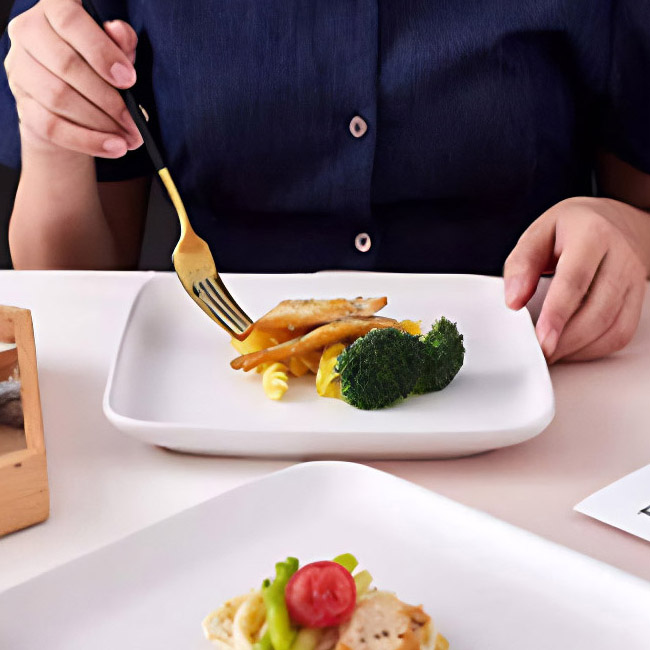
In a school cafeteria, one serving line moves more plates, bowls and trays in two hours than a sit-down restaurant handles all day. Trays hit the tile, bowls slide off crowded carriers, and somebody sweeps up chipped ceramic before the next wave of students arrives.
Most operations managers see that breakage as a single line on a spreadsheet. They glance at “replacement dinnerware,” approve it, and move on. The bigger number sits outside that line: the labour of clearing a serving area mid-rush, the safety incidents, and the reorders that land every few months.
Heavy duty melamine trays and bowls have become the default spec for food courts, institutional cafeterias, and any operation running thousands of service cycles a week. This guide covers what fragile tableware costs you, the design details that separate a real heavy-duty spec from a look-alike, and what to verify in a supplier before signing a bulk order.
Quick take:
- Genuine A5 melamine lasts 3-5 years in cafeteria service. Ceramic averages 3-6 months.
- For a 500-seat operation, the switch pays for itself inside twelve months.
- Three specs decide it: drop resistance, edge taper for stacking, and handle geometry.
- Before you commit, ask for a sample from the exact resin batch you will receive.
The Hidden Cost of Fragile Cafeteria Dinnerware
A case of ceramic bowls looks cheap at $0.80 a unit. Multiply that by the replacement rate and the number changes shape entirely. Cost of ownership sits outside the invoice, which is how it survives budget review year after year.
The spend comes from three failure modes:
- Ceramic shatters on the first hard drop. Beyond the lost unit, you absorb the downtime of sweeping a serving line, the risk of a cut to a staff member or guest, and the disposal cost of sharp debris.
- Thin polypropylene (PP) and polystyrene (PS) warp and stain. Tomato, turmeric and curry take up permanent residence. The tray looks tired within months, which drags down the perceived quality of the food it carries.
- Neither option stacks cleanly. You lose back-of-house storage and dish-room capacity to sprawl, and that sprawl costs rack space and labour every shift.
For operators looking to scale restaurant chains, standardising on durable, uniform tableware reduces operational friction across sites. When every location runs the same resilient spec, training, restocking and replacement all get simpler, and a broken tray in one city no longer means a different replacement in the next.
Here are the three common options side by side on the metrics that move cost:
| Feature | Standard Ceramic | Cheap Plastic (PS/PP) | Heavy-Duty A5 Melamine |
|---|---|---|---|
| Drop resistance | Low (shatters easily) | Medium (cracks/warps) | High (resilient, bounces) |
| Lifespan in cafeteria | 3-6 months | 6-12 months | 3-5 years |
| Stackability | Poor (risk of chipping) | Good | Excellent (space-saving) |
| Aesthetic retention | High (until broken) | Low (scratches/yellows) | High (retains gloss) |
Where the Money Hides
Three rows in that table carry most of the decision.
Lifespan. The 3-5 year service life of heavy-duty A5 melamine comes from resin density and the way the material absorbs impact instead of transmitting it. Thickness and resin grade drive this more than anything else, which is why A5 grade and wall thickness matter so much on a commercial spec sheet.
Appearance retention. A scratched, yellowed tray makes a $12 meal look like a $4 one, and no invoice captures that loss. Pair a heavy-duty body with a scratch-resistant finish and the tray still looks presentable after thousands of commercial wash cycles.
Stackability. This is where space-constrained kitchens save money you can measure. Poor stacking means more rack space, more dishwasher loads, and more trips between the pit and the line.
Run the Numbers on a 500-Seat Cafeteria
Take a 500-seat cafeteria serving two meals a day, with 1,500 bowls in rotation. Ceramic bowls chip enough to force a reorder at around four months, so you buy that inventory three times a year.
| Standard ceramic | Heavy-duty A5 melamine | |
|---|---|---|
| Unit price | $0.80 | $2.50 |
| Service life | ~4 months | ~4 years |
| Cost per full replacement (1,500 units) | $1,200 | $3,750 |
| Annual dinnerware spend | $3,600 | $0 after year one |
| Four-year total | $14,400 | $3,750 |
Two things stand out.
- The crossover arrives fast. Cumulative ceramic spend passes the one-time melamine outlay somewhere between month eight and month twelve. Every month after that is savings on the dinnerware line.
- Per-use cost collapses. A $2.50 bowl surviving roughly 1,600 services over four years works out to about a sixth of a cent each time it leaves the rack.
Neither figure counts the labour of sorting broken pieces or the occasional slip-and-cut claim. Operators who have run the switch across a whole site report replacement-cost reductions of up to 70%, which tracks with the four-year totals above.
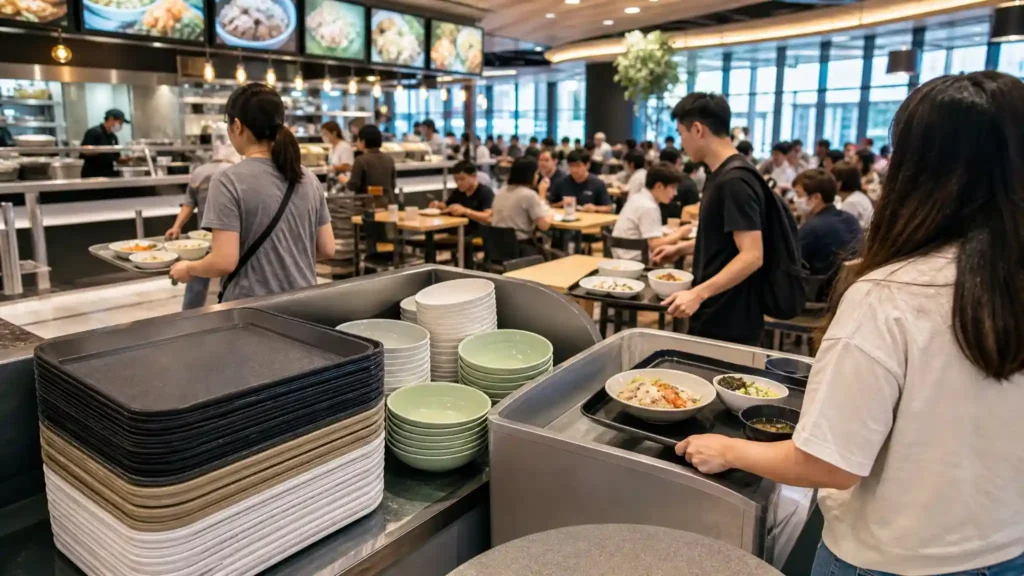
3 Design Features of Heavy Duty Melamine Trays
Specifying a tray comes down to matching material behaviour to the three stresses your dinnerware meets every shift: impact, storage density, and the hand carrying it. These are the details that separate a true heavy-duty spec from a look-alike.
Drop Resistance for Busy Service Lines
Genuine A5 melamine is a thermoset resin. It cures into a fixed, cross-linked structure rather than a meltable plastic, and that structure lets a tray hit a concrete floor and rebound instead of shatter.
In university food courts, hospital cafés and outdoor patios where a gust or a bump sends a tray sliding, drops happen every shift rather than once a month. Impact absorption buys you two things:
- No shards. A clean floor means no laceration risk and no 20-minute shutdown to safe-sweep a serving area.
- No silent loss. A cracked ceramic bowl goes in the bin. A melamine one goes back in the rack.
In a 500-seat operation, tray and bowl drops add up quickly once you count bus-tub transfers and self-serve lanes. With ceramic, each drop means a removal and a sweep. With melamine, most end with someone rinsing the item and racking it while service keeps moving.
Melamine also holds up outdoors. High-quality A5 resists UV degradation and stays tough through a season in direct sun, where standard plastics turn brittle. One caveat worth knowing: over prolonged exposure, dark colours can shift more than pale ones, so specify lighter tones for permanent patio service.
Stackability for Tight Back-of-House Space
Back-of-house square footage is some of the most expensive space in a food operation. Every inch of shelf and every slot in the dish machine has to earn its keep.
Well-engineered heavy-duty trays and bowls use a precise edge taper, a slight angle on the rim that lets units nest tightly without wedging. That single detail delivers:
- More pieces per shelf foot in dry storage.
- More pieces per rack in the dish machine, so fewer cycles to clear a rush.
- Stacks that stay upright when a loaded bus tub gets nudged.
You can test this without a spec sheet. Stack twenty of your current trays, stack twenty samples beside them, and measure both. The difference in height is the shelf space you get back on day one, and it repeats in every dishwasher rack after that.
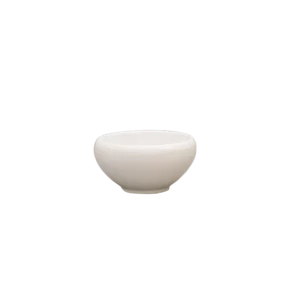
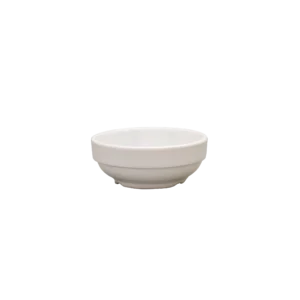
When you explore our catalogue of durable melamine food court trays and bowls bulk options, look for engineered edge geometry built for institutional use rather than a consumer product scaled up. The matching melamine bowl range follows the same nesting logic, which keeps your trays and bowls on one storage system.
Ergonomic Handles for Staff Safety
Speed on a cafeteria line is set by the slowest hand carrying the heaviest load. Trays and soup bowls with ergonomic handles shift that equation. A contoured grip:
- Reduces the force a server needs to carry a full tray, cutting fatigue across a double shift.
- Lowers slip risk, so fewer drops, which loops back to the breakage exposure above.
- Lets one person move more per trip, shortening customer waits at peak.
For soup and combo bowls, an integrated handle also keeps knuckles away from hot contents and removes a burn claim from your risk register. Product photos never show any of this. Your floor staff feel it by the second hour of a double.
High-turnover operations notice it most. When half your line staff are seasonal or student workers, a tray that feels safe to carry cuts both training time and incident reports during a 12-minute lunch window.
Choosing an Institutional Dinnerware Supplier
A bulk dinnerware order is a supply commitment that has to survive your worst week of the year. The right supplier is the difference between a smooth back-to-school launch and a serving line running on mismatched borrowed stock.
Three things separate a sourcing partner from a vendor:
Capacity that matches your peaks. Cafeterias do not reorder on a smooth curve. Demand spikes at semester open, holiday breaks and summer camp season. A manufacturer holding the right certifications (ISO 9001, FDA, LFGB, SGS) with the production bandwidth to absorb a 3x surge protects you from stockouts when it counts.
Consistency across reorders. Colour, weight and rim geometry need to match the units you bought eighteen months ago. A reliable supply chain means your replacement trays do not arrive a shade off, forcing you to phase out a whole line early.
Quality control you can audit. Ask for the test reports up front. Genuine A5 melamine behaves predictably under heat and detergent. A blended or filler-heavy resin does not, and you find out after a few hundred wash cycles. The fundamentals are laid out in a thorough A5 commercial sourcing guide.
Questions to Ask Before a Bulk Run
Most vendors dodge at least two of these. Put them in writing before you release a production order.
- Can I have a sample from the exact resin batch I will receive? A generic showroom sample tells you nothing about the run in the mould. A batch sample tells you whether gloss and weight match the spec sheet in your hand.
- What is your realistic lead time at 2x my normal volume? A vague answer here means the partnership breaks in the week you need it most.
- How do you hold colour and logo consistent across reorders? For multi-site groups this is what turns tableware from a commodity into a recognisable part of your brand.
- Do you mould and colour in-house, or subcontract? In-house control is the only reliable way to keep batch-to-batch variation tight.
A manufacturer with genuine capacity headroom keeps you out of stockouts during peak semesters and holiday rushes. For a mid-size operator that headroom is worth more than a few cents of unit price, because a shortage during finals week is a service failure your students and staff remember.
Buyers who standardise on dongyu’s heavy-duty lines order against a fixed spec sheet, so a replacement tray ordered eighteen months later matches the ones already in rotation. Qualify the partner once and the dinnerware stops being a budget surprise.
The Bottom Line
Heavy duty melamine trays and bowls cost more per unit and considerably less per year. For a 500-seat cafeteria, the switch pays for itself inside twelve months, then keeps paying for another three.
Before you sign, confirm three things:
- The resin is genuine A5, backed by current test reports.
- The edge taper nests cleanly in the racks you already own.
- The manufacturer can absorb a 2x order at semester open.
Get those right and the dinnerware line stops being something you react to. Talk to a sourcing partner who can match the volume and consistency your operation runs on.
FAQs
What is the most durable plate shape for high-volume cafeterias?
Round and oval shapes with slightly raised, rolled rims hold up best. The rolled edge distributes impact if the plate is dropped, and the absence of sharp corners removes the spots where chipping usually starts.
Can heavy duty melamine trays withstand commercial dishwashers?
Yes. Genuine A5 melamine handles the high temperatures and harsh detergents of commercial dishwashers without warping, cracking or losing surface gloss, which is where cheaper plastics fail. Detailed cleaning guidance covers this.
Can you microwave heavy duty melamine trays and bowls?
No. Melamine is not microwave safe at any grade. The resin does not absorb microwave energy evenly, so the piece can overheat, craze or discolour. Transfer food to a microwave-safe vessel and serve on melamine.
How does stackable melamine dinnerware save money for food courts?
Stackable designs make better use of vertical storage in crowded back-of-house areas and let you load more items per dishwasher cycle. Fewer cycles means lower water, energy and labour costs across the year.
Is melamine tableware safe for outdoor patio dining in direct sunlight?
Yes. High-quality A5 melamine resists UV degradation and will not turn brittle the way standard plastics do outdoors. Over years of permanent sun exposure, darker colours can shift in tone sooner than pale ones, so lighter finishes are the safer specification for a fixed patio.
Upgrade your cafeteria’s efficiency. Stop spending budget on constant replacements. Equip your staff with tableware built for real service volume.
Browse Products Related to Heavy-Duty Trays & Bowls
Get a Custom Bulk Quote for Your Institution