
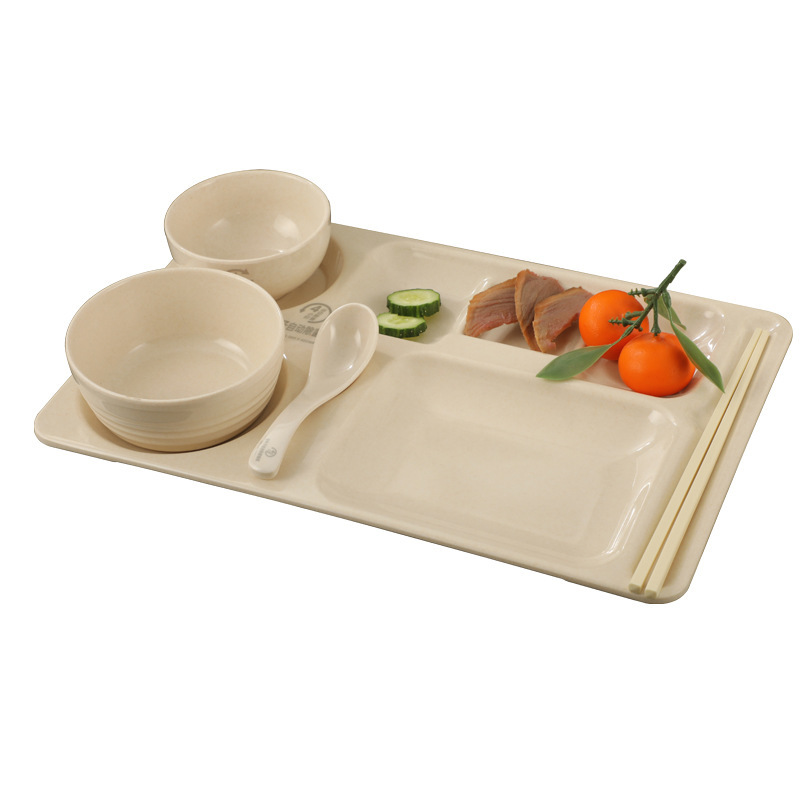
Walk any trade show and you will see bamboo melamine plates pitched as the plastic-free, plant-based answer to disposable tableware.
The pitch sounds right. The chemistry is not. A bamboo fiber plate still relies on a melamine resin binder, which means it is not plastic-free, and several studies show its chemical migration can run higher than plain melamine under heat. This article separates the eco label from the lab data, so you can read the claim before you buy.
Why “Bamboo” Sounds Greener Than It Is
Marketing teams reach for a few words because they test well with buyers, not because they describe the object on the shelf.
None of those words tell you what is actually in the plate.
The Words on the Box
- Plant based dinnerware sounds like it grew in a field.
- Green dinnerware implies a smaller footprint.
- Eco friendly melamine suggests a material that is gentle on the planet.
The Phrase to Watch Out For
The most telling phrase is one you almost never hear spoken aloud: biodegradable look plates.
It is a look, not a property. A bamboo blend plate can look earthy and feel light in the hand, yet still sit in a landfill for decades because the resin holding it together is thermoset plastic.
Buyers who judge by appearance alone get the story, not the substance.
Why Buyers Misread the Label
This gap between “looks green” and “is green” is where purchasing mistakes happen. A hotel that swaps ceramic for a bamboo blend to hit a sustainability target may end up with a product that fails the same dishwasher cycle it was bought to survive. For the wider picture, the real environmental impact of melamine comes down to where the resin is sourced and where a plate ends up once it finally breaks.
Consider a procurement manager placing her first volume order. She sees “plant based” and “eco” on the spec sheet, sees the speckled tan surface, and feels she has done the responsible thing. The supplier never says the word plastic. Bamboo melamine plates are easy to misread this way because the natural filler is visible and the resin is not.
The label does the persuading; the data stays in the lab where most buyers never look.
What Bamboo Melamine Plates Are Actually Made Of
Take a bamboo fiber plate and break it down and you find two parts:
- Ground bamboo, sometimes called bamboo powder or bamboo flour.
- A binder that holds those fibers together under heat and pressure.
That binder is melamine formaldehyde resin. Bamboo melamine dinnerware is, in plain terms, plant fiber suspended in a plastic matrix.
What Manufacturers Call It
Manufacturers also use the terms bamboo composite dinnerware and natural fiber melamine. They point to the same construction: a natural filler inside a synthetic resin.
- The bamboo gives the piece its speckled color and a lighter hand-feel.
- The resin gives it shape, hardness, and the ability to survive a commercial wash.
Here is the question buyers keep asking, and the honest answer: are bamboo plates really plastic free? They are not. The bamboo is real, but it is a filler, not the structure. Remove the resin and you do not have a plate. You have dust. That single fact reshapes every “eco” claim built on top of the word bamboo, and it should reshape how a buyer reads a catalog.
The Hidden Cost of High Filler Ratio
Purity is the part most buyers never see. A pure A5 resin cross-links into a dense, stable network when it cures.
Add bamboo powder and the mix still needs that same resin to hold shape, so a blend is never “less plastic” in any structural sense.
Bamboo melamine plates with a high filler ratio simply trade some resin for some plant fiber, and the fiber brings its own costs:
- more porosity
- more odor pickup
- weaker color fastness
None of that shows up in a catalog photo.
Bamboo Fiber vs Pure Melamine
A side-by-side view makes the trade-offs concrete. The table below compares a typical bamboo blend plate with a plain melamine plate made from pure A5 resin. Numbers are typical production values; confirm against a physical sample before you specify.
| Dimension | Bamboo blend plate | Pure melamine plate |
|---|---|---|
| Core material | Bamboo powder + melamine resin | 100% melamine resin (A5) |
| Weight feel | Lighter, slightly porous | Denser, smooth |
| Color stability | Fades and stains faster | Holds color through wash cycles |
| Odor pickup | Absorbs food smells over time | Resists odor when cured pure |
| Price per piece | Often similar or higher | Stable, scales with volume |
| Dishwasher life | Shorter at high heat | Longer at 70°C plus |
| Migration risk | Studies show higher under heat | Lower with pure A5 resin |
| Recycling | Hard to separate fiber from resin | Thermoset, reprocessed as filler |
What the Comparison Shows
The pattern is consistent. Bamboo fiber vs pure melamine is less a contest of good versus bad and more a choice between a lighter, earthier look and a longer, more predictable service life.
- The blend wins on shelf appeal.
- The pure resin wins on the numbers that matter to a kitchen manager.
That is also why many operators still reach for plain white. When a venue wants a clean, uniform look that will not shift after a hundred washes, plain white melamine plates stay popular for consistency more than fashion.
The bamboo blend has its place, but it is a different product with different limits and a shorter clock on color.
The Safety Question: Migration and Heat
What Really Drives Safety
The real concern is not the bamboo. It is what happens when the resin meets heat and acidic food.
Bamboo plates safety depends almost entirely on the quality of the melamine binder and how the piece is used. With a pure, fully cured A5 resin and normal service, migration stays within accepted limits.
The trouble starts with misuse and with cheaper mixes. Independent work on bamboo fiber blends has recorded higher levels of melamine and formaldehyde moving into food at elevated temperatures, which is exactly why “is bamboo melamine safe” gets asked so often. The honest answer: it is safe within the same envelope as any melamine product, and risky outside it. Do not microwave it. Do not ladle boiling soup into it and walk away.
Ask for the Migration Report
A proper bamboo melamine migration test measures how much substance leaches into a food simulant at a set temperature and time.
Ask any supplier for that report before you buy at volume.
If they cannot produce one, that silence is your answer. The data behind the melamine safety studies applies to blends too, and it points the same direction: heat is the variable to control.
What Regulators Say
Regulators have not been quiet. Bamboo dinnerware FDA approval is not a simple yes, because several markets have flagged bamboo-melamine blends and, in some cases, pulled products after testing found migration above limits.
The European Food Safety Authority and national agencies have issued similar cautions.
Treat “natural” as a reason to ask harder questions, not fewer. A food-safe line should come with paper to back the claim, not just a leaf on the logo.
Temperature Rules
The numbers help buyers set rules.
A commercial dishwasher runs around 70 to 85°C and that sits within normal service for a well-cured piece. Boiling stock at 100°C poured straight into the well is the danger zone, and a microwave adds both heat and steam that push the resin harder than any dish pit.
Bamboo melamine plates should be treated like any melamine here:
- hot-held and plated
- never microwaved
- never used as cookware
The “eco” story rarely mentions that fine print.
How to Read an “Eco” Claim Before You Buy
Buyers do not need a chemistry degree to avoid a bad purchase.
Most bad orders happen because someone skipped the first check, trusted the photo, signed, and met the real product three weeks later at the loading dock.
A five-step check strips most of the spin off an eco claim, and it takes minutes on a laptop before you commit:
- Read the material line. If it says melamine resin, bamboo powder, or composite, you are holding a plastic-matrix product, not a plant one. The word bamboo describes the filler, not the structure.
- Ask for migration data. A supplier confident in its resin will send the test report without a fight. No report, no order, no exceptions for a good price.
- Check the certifications. FDA, LFGB, or EFSA positions matter more than a leaf icon on the catalog. A real cert names a standard and a date.
- Confirm microwave use. If the answer is “we do not recommend it,” the eco story just lost its edge over standard melamine, which also should not be microwaved.
- Look for end-of-life detail. “Biodegradable” with no composting standard and no facility is a slogan, not a plan. Ask where the plate actually goes.
When Bamboo Blend Makes Sense, and When It Does Not
Where the Claim Holds Up
I am not here to bury bamboo blend plates. They look good on a rustic table, they weigh less in a server’s hand, and for cold or room-temperature service they do the job.
A cafe that wants a warm, natural aesthetic for a dessert counter has a fair reason to choose them.
Where the Claim Falls Down
They stop making sense when the claim outruns the product.
- If a sales deck says “plastic-free” next to a bamboo melamine plate, that is false.
- If it says “more sustainable” without showing a lifecycle study, that is unproven.
- And if the venue runs a high-heat dish pit and hot plating all day, the shorter service life will show up on the replacement invoice before the sustainability report ever does.
Two Venues, Two Answers
Picture two venues. A garden wedding caterer serving cold canapes for four hours values the rustic look and light weight, and a blend plate fits the brief. A 200-seat fast-casual spot plating hot food across three shifts values survival, and bamboo melamine plates will cost more in replacements there than plain melamine would.
Same word on the box, opposite right answer.
The job decides the material, not the marketing.
The Real Proof
Sustainable tableware is a real goal, but the word on the box is not the proof.
The proof is:
- the resin grade
- the test data
- the way the plate behaves after a thousand washes
Pick on those, and the “eco” label becomes a footnote instead of the selling point. Plain melamine with documented specs often beats a blend on the metrics a buyer can actually verify.
FAQs
Q: Are bamboo melamine plates safe?
Safety depends on the resin and the use. Bamboo fiber plates are still built on a melamine binder, so the same rules apply as to any melamine product: avoid microwave use and very high heat. Choose a supplier who can show a migration test, and the risk stays within normal bounds.
Q: Do bamboo plates contain melamine?
Yes. Most bamboo fiber plates and bamboo composite dinnerware use bamboo powder held together with melamine formaldehyde resin. They are not plastic-free. Only plates made from solid wood or solid bamboo, with no resin binder, skip the melamine entirely.
Q: Is bamboo melamine more eco-friendly than regular melamine?
Not automatically. The bamboo is a filler inside the same kind of resin, so the environmental math depends on sourcing, lifespan, and what happens at end of life. A longer-lasting pure melamine plate can beat a shorter-lived blend on real footprint, even without the plant label.
Q: Can bamboo melamine plates go in the dishwasher?
Usually yes in a commercial machine at 70°C and above, but skip the microwave and long high-heat food contact. Because the blend is more porous, it tends to pick up odors and lose color faster than pure melamine over repeated cycles.
Q: How do I check if a bamboo plate claim is real?
Read the material line for any melamine resin, ask for a third-party migration report, confirm the regulatory position in your market, verify microwave guidance, and look for a real composting or recycling standard. A claim with no data behind it deserves doubt.
Bamboo melamine plates are not the plastic-free swap the label implies, and the greener choice depends on what you can prove, not what the booth sign says. If you want a dinnerware line with documented migration data and clear certifications, browse our food-safe plain melamine dinnerware and request a spec sheet and sample kit before you commit to a volume order.
Inquiry for pricelist → contact us
Get a spec sheet and sample kit with documented migration data.